

How To Draw Phase Diagrams Chemistry
Phase Diagrams
- Page ID
- 1535
Phase diagram is a graphical representation of the physical states of a substance under dissimilar conditions of temperature and pressure level. A typical stage diagram has pressure on the y-axis and temperature on the x-axis. Equally we cross the lines or curves on the stage diagram, a phase alter occurs. In addition, two states of the substance coexist in equilibrium on the lines or curves.
Introduction
A phase transition is the transition from one land of affair to another. In that location are iii states of affair: l iquid, solid, and gas.
- Liquid: A state of matter that consists of loose, free moving particles which form the shape fix past the boundaries of the container in which the liquid is in. This happens considering the motility of the individual particles within a liquid is much less restricted than in a solid. One may notice that some liquids period readily whereas some liquids flow slowly. A liquid's relative resistance to period is viscosity.
- Solid: A state of matter with tightly packed particles which do not change the shape or volume of the container that information technology is in. Nonetheless, this does non mean that the book of a solid is a abiding. Solids tin expand and contract when temperatures change. This is why when you wait up the density of a solid, it will indicate the temperature at which the value for density is listed. Solids have strong intermolecular forces that keep particles in close proximity to one another. Some other interesting thing to think about is that all true solids have crystalline structures. This ways that their particles are arranged in a three-dimensional, orderly pattern. Solids will undergo stage changes when they come up across energy changes.
- Gas: A state of affair where particles are spread out with no definite shape or volume. The particles of a gas will take the shape and fill the book of the container that information technology is placed in. In a gas, there are no intermolecular forces holding the particles of a gas together since each particle travels at its own speed in its own direction. The particles of a gas are frequently separated past groovy distances.
Phase diagrams illustrate the variations between usa of matter of elements or compounds as they relate to force per unit area and temperatures. The post-obit is an instance of a phase diagram for a generic single-component system:

- Triple indicate – the point on a phase diagram at which the three states of matter: gas, liquid, and solid coexist
- Critical indicate – the bespeak on a phase diagram at which the substance is duplicate between liquid and gaseous states
- Fusion(melting) (or freezing) bend – the curve on a phase diagram which represents the transition between liquid and solid states
- Vaporization (or condensation) curve – the curve on a phase diagram which represents the transition between gaseous and liquid states
- Sublimation (or degradation) bend – the bend on a phase diagram which represents the transition between gaseous and solid states
Phase diagrams plot pressure level (typically in atmospheres) versus temperature (typically in degrees Celsius or Kelvin). The labels on the graph represent the stable states of a arrangement in equilibrium. The lines represent the combinations of pressures and temperatures at which two phases can exist in equilibrium. In other words, these lines define phase alter points. The red line divides the solid and gas phases, represents sublimation (solid to gas) and degradation (gas to solid). The green line divides the solid and liquid phases and represents melting (solid to liquid) and freezing (liquid to solid). The blue divides the liquid and gas phases, represents vaporization (liquid to gas) and condensation (gas to liquid). There are likewise 2 important points on the diagram, the triple point and the critical point. The triple indicate represents the combination of pressure and temperature that facilitates all phases of matter at equilibrium. The critical bespeak terminates the liquid/gas stage line and relates to the critical pressure, the force per unit area higher up which a supercritical fluid forms.
With most substances, the temperature and pressure related to the triple point lie below standard temperature and pressure and the force per unit area for the critical signal lies to a higher place standard pressure. Therefore at standard pressure as temperature increases, most substances change from solid to liquid to gas, and at standard temperature equally pressure level increases, well-nigh substances alter from gas to liquid to solid.
Exception: H2o
Unremarkably the solid/liquid phase line slopes positively to the right (every bit in the diagram for carbon dioxide below). However for other substances, notably water, the line slopes to the left as the diagram for water shows. This indicates that the liquid phase is more than dumbo than the solid stage. This phenomenon is acquired past the crystal structure of the solid stage. In the solid forms of water and some other substances, the molecules crystalize in a lattice with greater boilerplate space between molecules, thus resulting in a solid with a lower density than the liquid. Considering of this phenomenon, one is able to melt ice simply past applying pressure and non by adding heat.
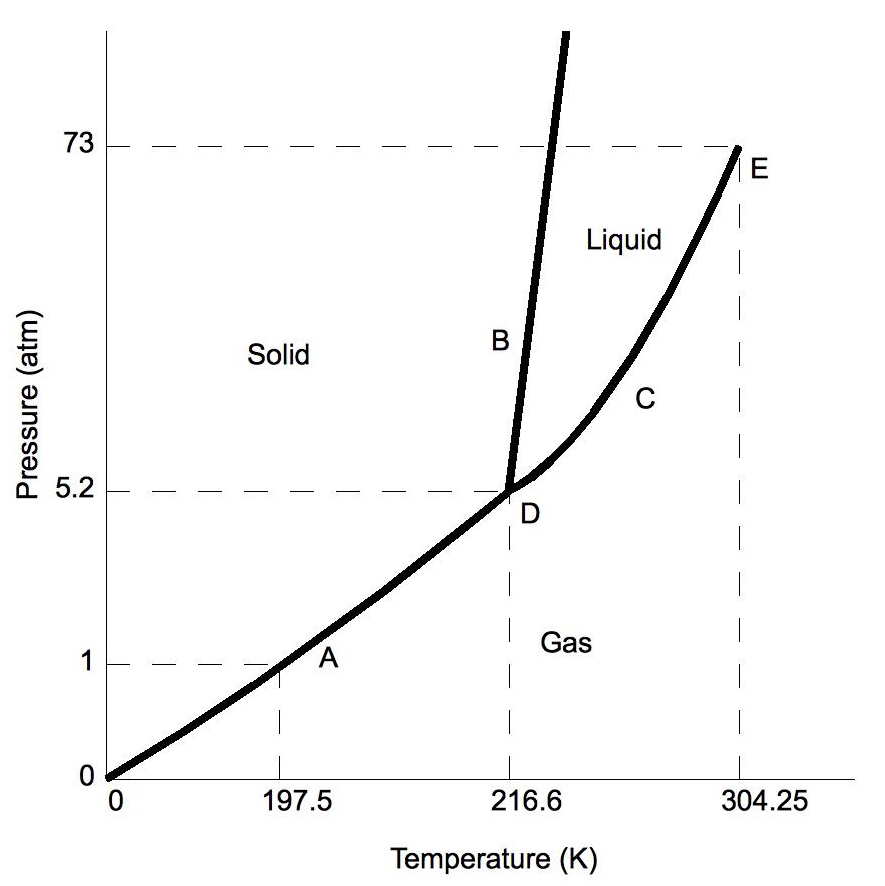
Figure \(\PageIndex{2a}\): Phase diagrams for CO2
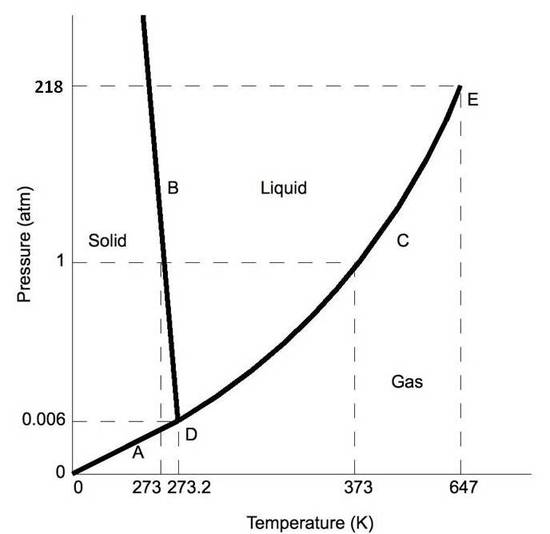
Effigy \(\PageIndex{2b}\):Stage diagrams for H2O
Moving Almost the Diagram
Moving about the phase diagram reveals information well-nigh the phases of matter. Moving along a constant temperature line reveals relative densities of the phases. When moving from the bottom of the diagram to the top, the relative density increases. Moving along a abiding pressure level line reveals relative energies of the phases. When moving from the left of the diagram to the right, the relative energies increases.
Important Definitions
- Sublimation is when the substance goes directly from solid to the gas country.
- Deposition occurs when a substance goes from a gas state to a solid country; it is the contrary process of sublimation.
- Melting occurs when a substance goes from a solid to a liquid state.
- Fusion is when a substance goes from a liquid to a solid state, the reverse of melting.
- Vaporization (or evaporation) is when a substance goes from a liquid to a gaseous country.
- Condensation occurs when a substance goes from a gaseous to a liquid state, the reverse of vaporization.
- Disquisitional Bespeak – the point in temperature and pressure on a phase diagram where the liquid and gaseous phases of a substance merge together into a single phase. Across the temperature of the disquisitional point, the merged single phase is known every bit a supercritical fluid.
- Triple Point occurs when both the temperature and pressure of the three phases of the substance coexist in equilibrium.
References
- Kotz, John C., and Paul Jr. Treichel. Chemistry & Chemical Reactivity. Due north.p.: Saunders Higher Publishing, 1999.
- Oxtoby, David W., H. P. Gillis, and Alan Campion. Principles of Modern Chemistry. Belmont, CA: Thomson Brooks/?Cole, 2008.
- Petrucci, Ralph, and William Harwood. F. Geoffrey Herring. Jeffry Madura. General Chemistry: Principles and Modern Applications. 9th ed. Upper Saddle River, NJ: Pearson, 2007.
- Vollmer, John J. "Out of "Thin Air": Exploring Phase Changes.' J. Chem. Educ. 2000: 77, 488A.
Problems
Imagine a substance with the post-obit points on the phase diagram: a triple signal at .5 atm and -5°C; a normal melting point at twenty°C; a normal humid point at 150°C; and a critical bespeak at 5 atm and 1000°C. The solid liquid line is "normal" (meaning positive sloping). For this, complete the following:
1. Roughly sketch the stage diagram, using units of atmosphere and Kelvin.
- Answer
-
i-solid, ii-liquid, iii-gas, 4-supercritical fluid, betoken O-triple bespeak, C-critical signal -78.5 °C (The phase of dry out ice changes from solid to gas at -78.5 °C)
2. Rank the states with respect to increasing density and increasing free energy.
3. Describe what 1 would see at pressures and temperatures above v atm and m°C.
- Answer
-
One would see a super-disquisitional fluid, when budgeted the point, i would see the meniscus between the liquid and gas disappear.
iv. Depict what will happen to the substance when it begins in a vaccum at -15°C and is slowly pressurized.
- Reply
-
The substance would begin every bit a gas and equally the pressure increases, information technology would compress and somewhen solidify without liquefying as the temperature is below the triple point temperature.
5. Describe the phase changes from -80°C to 500°C at ii atm.
- Respond
-
The substance would melt at somewhere around, just higher up 20°C and then boil at somewhere around, but higher up 150°C. It would not class a super-disquisitional fluid as the neither the pressure nor temperature reach the disquisitional pressure or temperature.
six. What exists in a system that is at 1 atm and 150°?
- Answer
-
Depending on how much free energy is in the organisation, there will be different amounts of liquid and gas at equilibrium. If merely enough energy was added to raise the temperature of the liquid to 150°C, there will but be liquid. If more than was added, at that place will be some liquid and some gas. If but enough free energy was added to change the state of all of the liquid without raising the temperature of the gas, at that place will but be gas.
7. Characterization the area i, 2, 3, and 4 and points O and C on the diagram.
8. A sample of dry water ice (solid CO2) is cooled to -100 °C, and is attack a table at room temperature (25 °C). At what temperature is the charge per unit of sublimation and degradation the same? (Assume pressure is held constant at 1 atm).
Contributors and Attributions
- Matthew McKinnell (UCD), Jessie Verhein (UCD), Pei Yu (UCD), Lok Ka Chan (UCD), Jessica Dhaliwal (UCD), Shyall Bhela (UCD), Candace Wong-Sing (UCD)

Source: https://chem.libretexts.org/Bookshelves/Physical_and_Theoretical_Chemistry_Textbook_Maps/Supplemental_Modules_(Physical_and_Theoretical_Chemistry)/Physical_Properties_of_Matter/States_of_Matter/Phase_Transitions/Phase_Diagrams
Posted by: whitakertecame.blogspot.com
0 Response to "How To Draw Phase Diagrams Chemistry"
Post a Comment