

What Was The Ethnic Makeup Of Russia?
Russian Culture: Facts, Community & Traditions
Russian civilisation has a long and rich cultural history, steeped in literature, ballet, painting and classical music. While outsiders may meet the country as drab, Russia has a very visual cultural past, from its colorful folk costumes to its ornate religious symbols. Here is a cursory overview of Russian customs and traditions.
The Homeland
Russian civilization places a high value on the homeland and on family, co-ordinate to Talia Wagner, a marriage and family therapist with a specialty in cultural dynamics. "The Soviet rule left its impression on the culture, creating a fundamental fear and mistrust of those outside the family, extended family unit and other close familial connections," she told Live Science. The Communist Political party ruled Russian federation and neighboring territories for more than seventy years, uniting them into the Matrimony of Soviet Socialist Republics (USSR). The Soviet Union broke up in 1991.
"The challenges families faced under communism left individuals highly dependent on family support, which oftentimes required the combining of resource to survive," Wagner connected. "This created a culture that highly values extended family and maintaining close friendships."
When many people recall of Russia, they remember of vast, frozen tundra. That's not all in that location is to the country's geography. At that place are plains, taigas, steppes, plains and mountains. [Russia from To a higher place: A Glimpse at a Vast Landscape]
For instance, in 2017 the Russian volcano called Kambalny erupted after nearly 250 years of dormancy. The eruption was a surprise and the plume of fume could be seen from space.
"Nothing pointed to a possible eruption of the Kambalny," Olga Girina, head of KVERT, told Russian news bureau TASS, according to Russia Across the Headlines. "Information technology is a pure surprise for u.s.. Nosotros continue the monitoring and will analyze possible threats as data come in."
Some other amazing feature of Russia's geography is Lake Baikal. It is the world'due south largest lake and holds 20 percent of the world'southward supply of fresh h2o. Information technology is also the world's oldest lake.
"Lake Baikal is the oldest lake in the world. It is home to approximately i,700 to 1,800 endemic plant and creature species," said Jennifer Castner of Pacific Surround's Russia program.
Population and ethnic makeup
Russia is the largest land in the world in terms of territory, with a total area of half-dozen,601,668 square miles (17,098,242 square kilometers). Past comparison, the United States comprises iii,794,100 foursquare miles (9,826,675 square km).
According to 2016 data past The Earth Bank, the population of Russia is more than 144,000,000, a decline since its top of 148,689,000 in 1992.
Russian federation is home to at least 190 ethnic groups, co-ordinate to the BBC. The Central Intelligence Agency (opens in new tab) (CIA) reports that 77.vii percent of Russians are of Russian descent. The rest of the population consists of 3.vii percent Tatar, 1.4 percent Ukrainian, 1.ane percent Bashkir, one percent Chuvash, i per centum Chechen and x.2 percentage other, while 3.9 percentage are unspecified.
Languages
While Russian is the official linguistic communication, many Russians too speak English equally a 2d language. More than than 100 minority languages are spoken in Russia today, according to the BBC. The near popular is Dolgang, spoken by more 5.3 percent of the country'due south population, co-ordinate to the CIA. Other minority languages include Tartar, Ukrainian, Chavash, Bashir, Mordvin and Chechen. Although these minority populations account for a small pct of the overall Russian population, these languages are prominent in regional areas.
Religions
"Organized religion has ever been a chief component of Russian life, even during times of oppression," Wagner said.
At that place are most five,000 registered religious associations in Russia. More than half follow the Russian Orthodox Church, co-ordinate to the Ministry of Foreign Affairs of the Russian federation. Islam is the second largest religion; about 10 percent to fifteen percent of Russians practice Islam, co-ordinate to the CIA World Factbook.
"The tertiary most popular organized religion in Russia afterward Christianity and Islam is Tengrism, a course of pagan, animistic and shamanic religion," said Christina de Rossi, an anthropologist at Barnet and Southgate College in London. Tengrism originates from the Turk and Mongol populations of Central Asia and has enjoyed a revival in parts of Russian federation as it is seen equally part of a certain Central Asian indigenous identity past some regional independence movements.
Arts, literature and architecture
Ballet is a popular notable art form coming out of Russia. Founded in 1776, the Bolshoi Ballet is a classical ballet visitor based at the Bolshoi Theatre in Moscow and known throughout the earth. The Mariinsky Ballet in Petrograd is some other famous ballet company in Russia.
Peter Ilyich Tchaikovsky, a 19th-century Russian composer, is world renowned for "Swan Lake" and the "1812 Overture," amongst other pieces. There are several museums, including his childhood home, showcasing his personal belongings and musical artifacts.
Russian literature has also had a worldwide touch on, with writers such as Leon Tolstoy ("Anna Karenina" and "War and Peace") and Fyodor Dostoevsky ("Crime and Penalty" and "The Brothers Karamazov") nonetheless being read around the world.
Russian nesting dolls are well-known symbols of the country. These sets of dolls, known as matrioshka dolls, consist of a wooden effigy that tin can be pulled apart to reveal another smaller version of the same epitome inside, and then on, ofttimes with six or more dolls nested inside one another. The painting of each doll, which can exist extremely elaborate, ordinarily symbolizes a Russian peasant girl in traditional costume.
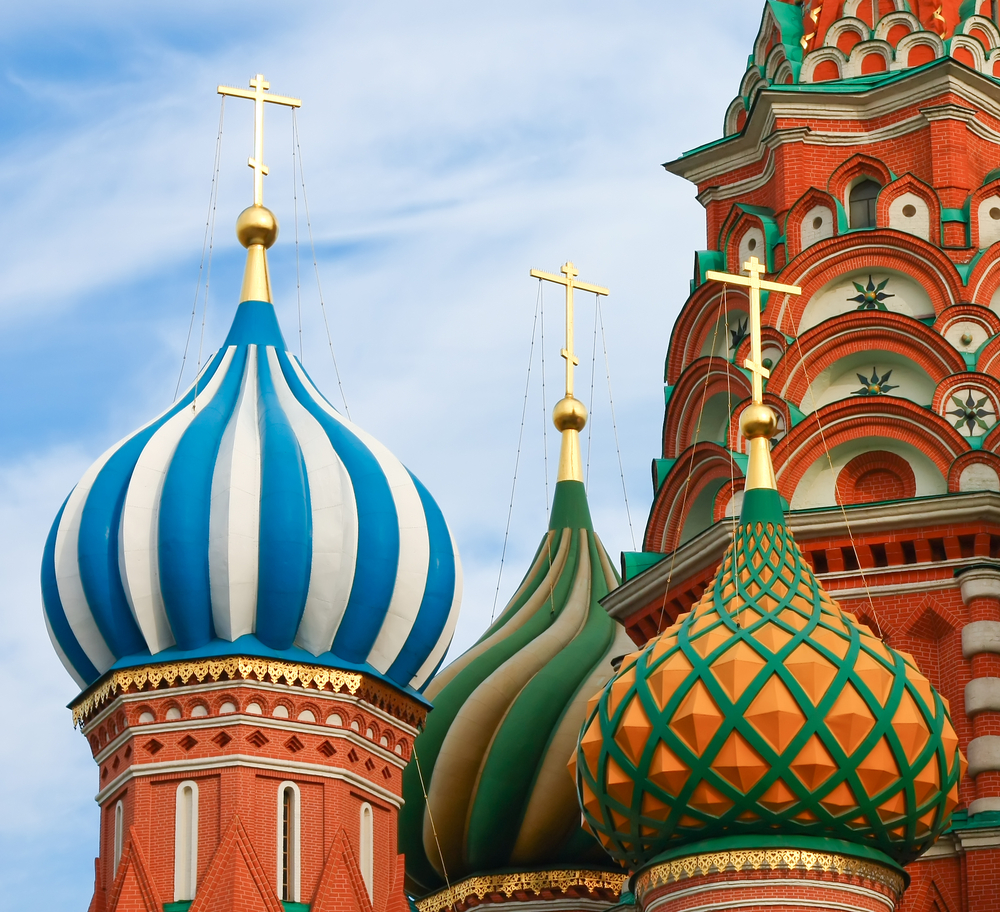
Colorfully painted onion domes kickoff appeared during the reign of Ivan the Terrible, co-ordinate to Lonely Planet. They are commonplace in Russian architecture and are predominant atop church building structures. It has been speculated that they represent called-for candles or vaults to sky and frequently appear in groups of 3 representing the Holy Trinity.
Russian food and potable
1 of the most well-known traditional Russian foods that may seem foreign to an outsider is borshch, besides spelled borscht. This is a beet soup that is total of vegetables and meat and is typically served with a dollop of sour cream, a staple of many Russian dishes.
Pirozhkis are small broiled buns that can be filled with potatoes, meat, cabbage or cheese. (They should not be confused with pierogis, which are Smoothen dumplings, boiled and and then fried and stuffed with meat, cheese, potatoes or sauerkraut.)
Caviar, or ikra, traditionally made from the eggs of sturgeon found in the Black Sea or Caspian Sea, is oft served on dark, crusty bread or with blini, which are similar to pancakes or crepes. Blini are also served rolled up with a variety of fillings, ranging from jam to cheese and onions, or even chocolate syrup.
Vodka is a pop alcoholic drink traditionally fabricated from the distillation of fermented potatoes. Beer and tea are as well widely consumed.
Folklore & holidays
Russia has a rich tradition of folk tales that derive from a number of Slavic myths and traditions, according to de Rossi. Russian folk characters are very colorful, and they also beguile ancient pagan roots: for example, the Baba Yaga is a witch-like old adult female who lives in the forest in a house that rests on craven legs and is surrounded by skulls and basic. Another tale tells of the Fire Bird, an enchanted creature with fiery plume that is very difficult to grab, therefore its capture or that of one of its feathers is frequently the challenge facing the hero.
Both the Baba Yaga and the Burn down Bird tin can either be good or bad, terrifying or benevolent, and they can bequeath favorable or hostile enchantments, de Rossi said. Above all, they must never be antagonized!
Some Russians observe Christmas on Jan. vii as a public holiday, co-ordinate to the Julian calendar used past the Russian Orthodox Church building, while others celebrate on Dec. 25.
Russian federation Day is celebrated on June 12. This marks the solar day in 1990 that the Russian parliament formally declared Russian sovereignty from the USSR, according to the School of Russian and Asian Studies. Initially, it was named Russian Independence Day, but was renamed to Russia Twenty-four hours, a proper noun offered past Boris Yeltsin, in 2002.
Boosted resources
- Mariinsky Ballet Website
- The Canopy over the Holy Sepulchre: On the Origin of Onion-Shaped Domes
- Passport to Trade: Business Coming together Protocol and Etiquette in Russia
Source: https://www.livescience.com/44154-russian-culture.html
Posted by: whitakertecame.blogspot.com
0 Response to "What Was The Ethnic Makeup Of Russia?"
Post a Comment